
Customer overview
A large national retail enterprise operating across the United States sought to modernize its business intelligence capabilities as part of an enterprise-wide digital transformation initiative. With thousands of employees, a vast product catalog, and nationwide operational complexity, the company relies heavily on timely, accurate, and scalable analytics to drive inventory management, merchandising strategy, supply chain planning, and store-level performance optimization.
For more than a decade, the retailer had used MicroStrategy as its primary business intelligence (BI) platform. While it supported reporting needs in the past, the system had become increasingly cost prohibitive and difficult to maintain. Legacy dashboards, fragmented data models, and outdated development patterns made enhancements slower and more expensive. These constraints ultimately limited the organization’s ability to expand analytics to new business domains.
The retailer partnered with MAQ Software, a leading Microsoft Solutions Partner, to modernize its BI ecosystem using Microsoft Fabric and Power BI, enabling a scalable, cost-efficient, and future ready foundation for enterprise analytics. efficient, and future ready foundation for enterprise analytics.
Business challenges
The customer faced a set of interlocking business and technical challenges that made continued reliance on MicroStrategy unsustainable.
-
High licensing costs
The MicroStrategy licenses cost twice as much as Power BI Fabric capacity. A 50% reduction in annual infrastructure costs meant the migration costs were recouped within a year. -
Legacy footprint
Much of the MicroStrategy environment had been built more than a decade earlier. The modernization initiative created an opportunity to collaborate with business teams to identify and remove unused legacy artifacts. -
Suboptimal user experience
Users replicated reports with preselected filters and saved them as separate dashboards, creating duplication, inconsistencies, and more content to maintain for the BI team. -
Single source of truth
The business wanted to avoid copies of data to ensure a single source of truth. This meant import models was not an option. -
Snowflake query costs
All analytics queries were executing directly in Snowflake. The customer was paying for MicroStrategy license and Snowflake queries for reports.
Scope
| 500+ | Reports |
|---|---|
| 10+ | Models |
| 2,000+ | Users |
| 1,300+ | Peak concurrent users |
| 200+ | GB of data |
| 11.5.6 | MicroStrategy version |
Solution overview
To solve these challenges, MAQ Software implemented a modern, scalable analytics architecture using:
· Microsoft Fabric
· Power BI
· Azure Data Lake Storage (ADLS)
· Iceberg table format for open lakehouse compatibility
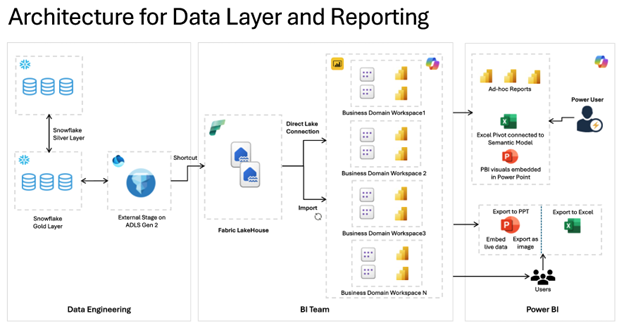
The customer kept Snowflake as its data engineering platform, while MAQ Software established a seamless integration pathway into Fabric to support enterprise BI workloads.
Technical architecture and implementation
-
Snowflake as the core data engineering platform
The customer preferred to keep all data engineering pipelines, transformations, and workflows in Snowflake. To honor this requirement, MAQ Software ensured:- No reengineering of existing Snowflake processes
- Full alignment of data definitions and data contract ownership
- Zero latency between Snowflake tables and BI consumption
-
Challenges with Direct Lake and DirectQuery
Two architectural constraints guided the solution:- DirectQuery on Snowflake is expensive, as every report interaction triggers Snowflake compute.
- Import mode was not feasible due to massive data volumes and real-time currency requirements.
-
Introducing Direct Lake via Iceberg tables in ADLS
Because Microsoft Fabric cannot create shortcuts directly on native Snowflake tables, MAQ Software designed an elegant hybrid architecture:- Snowflake engineering team publishes model-ready data to Iceberg tables on ADLS
- Microsoft Fabric creates shortcuts to these Iceberg tables
- Power BI connects using Direct Lake mode, enabling:
- High performance
- No data duplication
- Lower costs
- Real-time data alignment
- The engineering team to stay in Snowflake
- The analytics team to leverage Fabric + Power BI seamlessly
- Elimination of Snowflake query costs for reporting
- High concurrency without compute spikes
-
Content rationalization using MicroStrategy APIs
To streamline migration, MAQ Software used MicroStrategy APIs to:- Extract table and column usage across all reports
- Identify dormant or redundant models
- Map report dependencies
- Determine overlap between data sources
- Consolidate dashboards using logical grouping
This significantly reduced the scope by eliminating unused or duplicated content.
-
User-driven requirements gathering
Because reports were heavily used for ad hoc analysis, MAQ Software conducted extensive interviews with business users to:- Determine which fields were truly needed
- Validate what was no longer in use
- Understand analytical patterns (filters, drill paths, contexts)
- Redesign modern Power BI semantic models aligned to real-world usage
This produced cleaner, more intuitive datasets that accelerated adoption.
MAQ Software accelerators and IP used
MAQ Software leveraged specialized tools and methodologies to accelerate migration:
-
MicroStrategy API Extraction Accelerator
Used to analyze:- Fact/dimension dependencies
- Report lineage
- Model complexity
- Candidates for consolidation
- Attributes in artifacts
This output helped estimate the complexity of data models and estimate the development efforts needed for migration.
-
Scripts to extract metadata from Snowflake
After identifying Snowflake dependencies, scripts were used to get details of the artifacts:- Table size
- Number of columns
- Number of rows
These details, along with usage patterns, were used to estimate the Fabric SKU needed.
-
Direct Lake optimization patterns
MAQ Software implemented best practices for:- Iceberg-based lakehouse integration
- Shortcut management
- Delta refresh strategies
- High-performance model tuning
This ensured long-term operational efficiency.
Change management and user adoption
· Power BI training session: Conducted a Dashboard In a Day training in conjunction with Microsoft to provide basic training to users for creating and using reports in Power BI.
· Office hours: Conducted office hours with various business teams to understand their specific use cases and guided them through solutions for exports, presentations, and custom reports.
· Documentation: Created extensive documentation covering common use cases of end users based on the feedback from office hours.
Business impact
The modernization delivered significant operational and financial benefits.
-
50% reduction in BI licensing costs
Moving away from MicroStrategy cut license spend in half, allowing reinvestment into strategic analytics initiatives. -
Reduction in Snowflake compute costs
Because all BI queries shifted to Fabric, Snowflake no longer served reporting workloads, resulting in major compute cost savings. -
Scalable, future-ready BI platform
Power BI delivered:- Lower TCO
- Higher performance
- Modern visualization capabilities
- Greater flexibility for business teams
-
Improved content governance
Consolidation eliminated outdated artifacts and simplified the analytics landscape. -
Better user experience
Users gained:- Faster reports
- More intuitive filters
- Tailored ad hoc analysis capabilities
- A consistent enterprise data model
-
Modern architecture without rewriting engineering pipelines
By using Iceberg tables on ADLS, the solution maintained the following components while delivering a modern Power BI experience:- Existing Snowflake investment
- Existing team workflows
- Existing data governance frameworks
Ready to migrate?
MAQ Software offers end-to-end migration services from MicroStrategy, Tableau, SAP BOBJ, Databricks, and other platforms.
Check out our Microsoft AppSource offerings:
· MicroStrategy to Power BI Migration: Assessment & Pilot
· MicroStrategy to Power BI Migration: Free 3-Week Assessment
· MicroStrategy to Power BI Migration: Full Migration Engagement